

If you’ve ever worked in electronics manufacturing, semiconductor packaging, medical device assembly, or aerospace component fabrication, you’ve likely encountered the quiet, critical workhorse that is ESD Adhesive Tape—even if you didn’t stop to ask how it actually does its job. As a specialty tape supplier that’s focused on static control solutions for over a decade, I’ve seen this product resolve more headaches than I can count: from tiny microchips ruined by a single static discharge to entire circuit boards scrapped mid-assembly, all because someone used the wrong tape to hold parts in place. But what makes ESD tape different from every other tape on the shelf? Let’s break it down, step by step, no overly technical jargon, just real-world insights from the people who use (and sell) it every day.
First, let’s get one thing straight: ESD stands for Electrostatic Discharge, which is that sudden, invisible spark you feel when you touch a doorknob after walking across carpet. For a microchip with components measured in nanometers, that spark can pack thousands of volts of static electricity—way more than enough to melt a tiny circuit line or fry a sensitive internal component. Regular adhesive tape? It’s an insulator. It builds up static instead of dissipating it, turning a hold-down tool into a risk factor. That’s where ESD Adhesive Tape comes in: it’s engineered to balance two seemingly opposing properties—adhesion to hold parts firmly, and static dissipation to prevent dangerous discharge.
The magic starts with the tape’s core structure, which is not one layer but three, each designed for a specific purpose. Let’s pull it apart, layer by layer, to make this easy. The backer (the thin, flexible sheet you actually unroll) is the base of the product. For most ESD tape used in electronics, the backer is made of materials like polyester, polyimide, or PVC, but doped with conductive fillers—usually carbon black, metal particles, or conductive polymers—during manufacturing. These fillers don’t change how flexible the backer is (it still stretches and conforms to curved parts) but they make it a semi-conductor, not an insulator or a full conductor. A full conductor would let too much electricity flow and could damage delicate circuits; a semi-conductor is the sweet spot.
Next up is the adhesive layer, the part that sticks to your parts or work surface. Regular tape adhesive is almost always an insulator, so ESD adhesive has to be modified to be conductive too—without losing its stickiness. That’s a tricky balance. Too many conductive fillers in the adhesive, and it won’t stick well enough; too few, and it can’t dissipate static. Manufacturers mix specialized conductive additives (same family as the backer’s fillers, but formulated for bonding instead of structural strength) into a pressure-sensitive adhesive (PSA) base, like acrylic or rubber. The result is an adhesive that creates a low-resistance path for static electricity, while still holding down a 20-pound circuit board during wave soldering or aligning a tiny MEMS sensor for medical devices.
Wait, there’s a third layer, right? The release liner. It’s the thin, paper or plastic sheet you peel off before applying the tape. For ESD tape, this liner isn’t the same as the one on regular duct tape. It’s treated to be static-dissipative too, so when you unroll the tape, you don’t build up static in the process of peeling it from the liner. That’s a small detail, but it’s critical—if peeling the tape generates a static spark, you’ve already defeated the purpose of using ESD tape in the first place. A good ESD tape supplier will test every roll to make sure the liner doesn’t add to static risk.
Now, how does this structure actually work to stop ESD? Let’s walk through a common scenario: a electronics assembler is working on a batch of smartphone camera modules, each with a tiny image sensor that’s vulnerable to static. The operator applies ESD tape to hold the sensor in place on the workbench during soldering. When the operator moves around the bench, wears a grounding wrist strap, and touches the work surface, their body (and the work surface) is connected to ground, the point where static electricity is safely drained away. The ESD tape is the middle link here: its conductive backer and adhesive layer create a continuous, low-resistance path between the sensor (which might hold a small static charge from handling) and the grounded workbench. That charge flows slowly and steadily through the tape to ground, instead of building up until it jumps as a spark to the sensor.

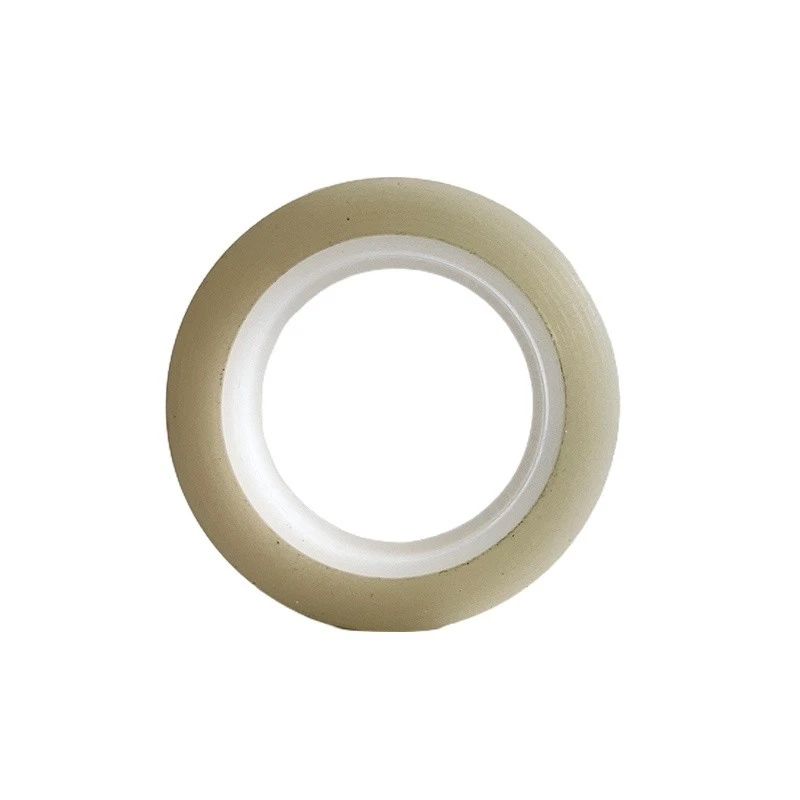
It’s not just holding parts—ESD tape is also used for masking during manufacturing steps that generate their own static. For example, when painting or coating metal parts, regular masking tape would build up static in the masked areas. ESD masking tape dissipates that static, so the coating adheres evenly without small spark-induced defects. I’ve had clients in aerospace tell me they use ESD tape to mask turbine blade components during plasma coating; a single static spark could create a tiny weak spot in the coating that leads to engine failure mid-flight, so the tape’s role isn’t just a convenience—it’s a safety requirement.
Of course, not all ESD tape is the same. There are different levels of surface resistivity, a key metric that measures how well a material conducts static. The standard range for ESD tape is 10^6 to 10^12 ohms per square—materials in this range are conductive enough to drain static within seconds, but not so conductive that they cause electrical interference with sensitive circuits. Some specialized ESD tapes go even lower, for high-risk environments like semiconductor wafer processing, where static can ruin an entire wafer worth of chips.
As a supplier, I often get asked: “Can’t I just use regular tape with a grounding wire?” The answer is no, because grounding wires are bulky and get in the way of small, precise assembly. ESD tape is integrated into the process—operators don’t have to fumble with wires while handling tiny parts. It’s also reusable in some cases? Wait, no, most ESD tape is a single-use product for the application it’s designed for, but there are options like UV Releasable Tape which is a subset of ESD tape that lets you remove parts later without leaving residue or generating static. That’s perfect for semiconductor testing, where you need to handle parts multiple times without damaging them.
We also frequently work with clients who need ESD tape paired with other specialty tapes for more demanding jobs. For example, when assembling heat-dissipating power modules, an ESD tape might be used to hold the module in place while a Double Sided Heat Transfer Tape handles heat management, or for high-heat environments like automotive under-the-hood electronics, we’ll pair ESD tape with Flame Retardant Adhesive Tape to add a layer of fire safety. There’s also Silicone Pet Tape which is compatible with sensitive silicone surfaces, a common need in medical device manufacturing where residue from adhesive tape can contaminate sterile components.
One thing I always emphasize to new clients is that ESD tape isn’t a one-size-fits-all product. Choosing the wrong type—like an ESD tape with too high a resistivity for a high-static environment—can lead to the same problems as regular tape. That’s why we work with clients to evaluate their specific process: are they working with microchips, or larger circuit boards? What temperature will the tape be exposed to during assembly? Will it need to hold parts through soldering, or just during transport? These details matter, and as a supplier, we don’t just sell tape—we help people pick the right tape for their job.
I’ve heard too many horror stories from manufacturers who tried to save a few bucks by using generic tape instead of ESD tape, only to end up with a batch of defective products that cost them thousands of dollars (or even their reputation). A friend who runs a small semiconductor packaging plant told me about a time they used regular masking tape on a batch of memory chips—less than 1% of the chips were defective at first, but by the time they got to a customer, 15% were ruined because of hidden static damage. The cost of switching to proper ESD tape? A fraction of the loss.
So, to circle back to the original question: how does ESD adhesive tape work? It’s all about intentional design. Every layer, every material choice, every metric (resistivity, adhesion strength, heat resistance) is calibrated to balance two needs: holding parts securely through every step of manufacturing, and quietly draining static electricity before it can do damage. It’s a small, unassuming product, but in industries where even a single spark can be costly, it’s irreplaceable.
If you’re working on a project that needs static control, precision adhesion, or specialty tape solutions, we’re here to help. Our team has years of experience matching the right tape to your specific application, whether you need standard ESD Adhesive Tape, or one of our other specialty products. We collaborate with clients across electronics, medical, aerospace, and automotive industries, so we understand the unique challenges each sector faces. Reach out to our team to discuss your needs and get a customized solution that fits your process.
References
- “Electrostatic Discharge Control: Principles and Practices,” ESD Association, 2021.
- “Specialty Adhesive Tapes for Electronics Manufacturing,” Journal of Electronic Materials, Vol. 49, No. 3, 2020.
- “Surface Resistivity Standards for Static Control Materials,” International Electrotechnical Commission (IEC) 61340-5-1, 2016.
- “Adhesive Selection for Static-Dissipative Applications,” Journal of Adhesion Science and Technology, Vol. 34, No. 12, 2020.